
7 Fascinating Insights on How the Bible Organized
If you have ever opened the Bible, flipped a few pages, and quietly wondered how the whole thing fits together, you are in good company. Understanding how the Bible is organized helps us understand the Bible in a deeper way. The Bible is not one long book written start to finish. It is a library of 66 books, gathered into two testaments, sorted by the kind of writing each one is.
When we can understand the structure of the Bible, it helps us understand the actual words and message better. That is what I want for you here. It’s not something else for you to keep straight, it’s just a tool to help you in your study.
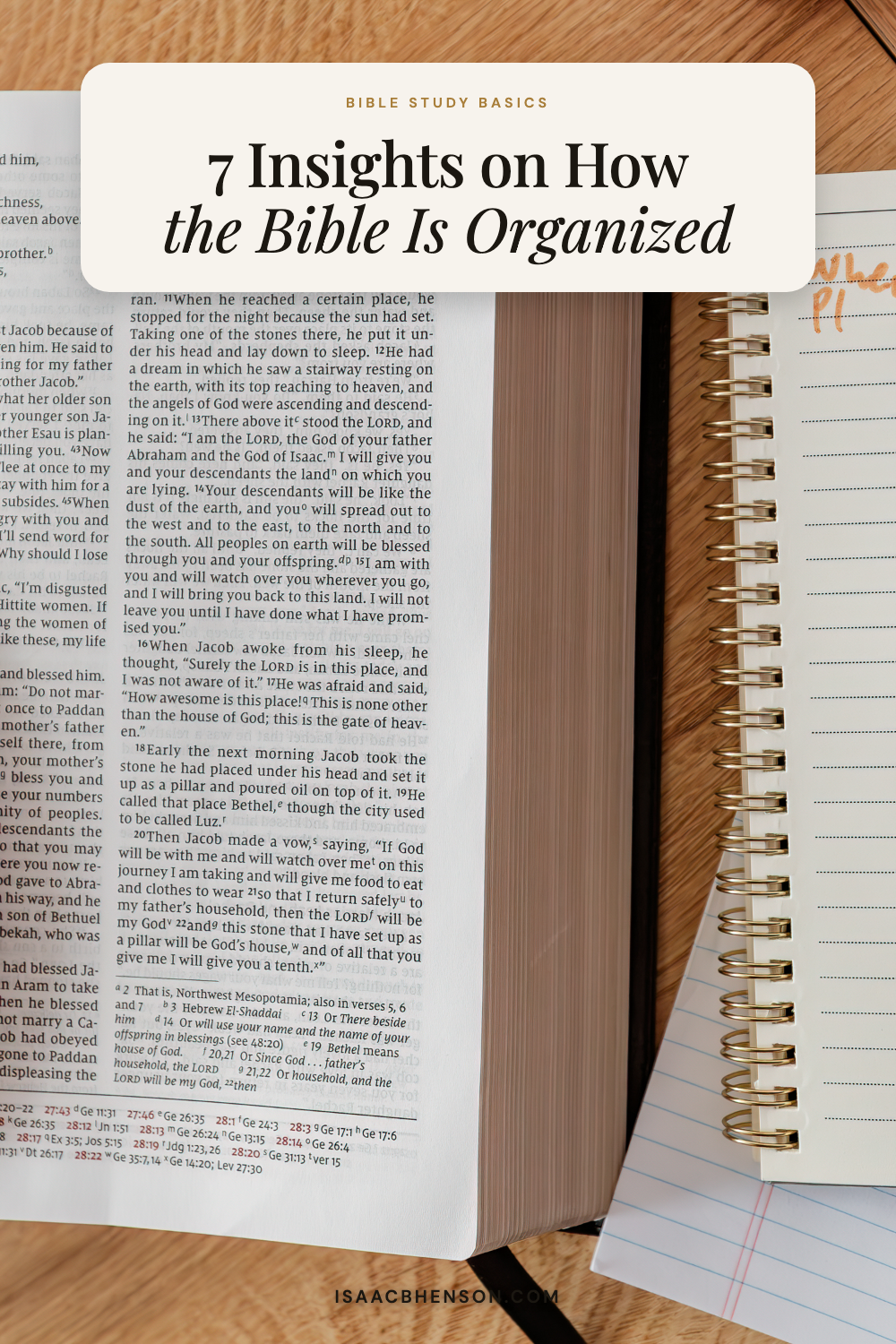
The Structure of the Bible: Two Testaments, One Story
The Bible is made up of two main parts: the Old Testament and the New Testament. The word testament means covenant, a binding promise between God and His people. The Old Testament holds 39 books and tells the long story of God forming a people, giving them His law, and promising a rescuer. The New Testament holds 27 books and tells what happened when that rescuer came: the life, death, and resurrection of Jesus, and the church that followed.
So when people ask how the Bible is broken down, the first and biggest answer is this: Old Testament, then New Testament. Promise made, then promise kept.
These two parts are not two different stories. They are one story with one center. Jesus said it plainly when He told the religious leaders, “You pore over the Scriptures because you think you have eternal life in them, and yet they testify about me” (John 5:39 CSB). The Old Testament leans forward toward Him. The New Testament looks back and says, here He is.
That is the heartbeat under the structure. Every shelf in this library points to one Person.
Categories of the Bible: The Books of the Bible Divisions
Inside those two testaments, the books are grouped into categories. These books of the bible divisions are not random. They cluster books that do similar work. Here is the simplest way to hold the categories of the Bible in your head.
The Pentateuch (the Law). The first five books, Genesis through Deuteronomy. Pentateuch simply means “five books.” This is where the stories of creation, the flood, Abraham, and Moses live. God makes the world, chooses a people, and gives them His commands.
The Historical Books. Joshua through Esther. These trace the nation of Israel across centuries: judges, kings and battles, faithfulness and failure, exile and return. If you have read Noah's ark or David and Goliath with your kids, you have already stood in this part of the library.
Wisdom Literature. Job through Song of Songs. These books are much more poetic. They speak about suffering, doubt, joy, longing. The Psalms are prayers and songs. Proverbs is plain wisdom for daily living. Job talks about a historical thing that happened, but it focuses much more on Job’s response to God in his crisis and how God responded.
The Prophets. Isaiah through Malachi, split into the Major and Minor Prophets (major and minor refers to length, not importance). These are God's servants and messengers calling His people back into relationship with Himself and pointing ahead to the Messiah.
That covers the Old Testament. The New Testament has its own categories.
The Gospels. Matthew, Mark, Luke, and John. Four accounts of the life of Jesus, told from four angles. Not four contradicting stories, but four witnesses to one Lord.
Church History. The book of Acts, which tells how the gospel spread after Jesus rose from the dead. It picks up where the Gospel of Luke leaves off, and it’s written by the same person (Luke).
The Letters (Epistles). Romans through Jude. Letters written to real churches and real people, full of instruction, correction, and comfort. Paul wrote many of them. They read like mail, because that is what they are.
Prophecy. The book of Revelation, which closes the library with a vision of how the whole story ends: God making all things new. Sometimes you’ll hear this described as ‘apocalypse’ instead of prophecy. Both are correct for the purpose of this discussion.
How Is the Bible Broken Down by Genre: Types of Books in the Bible
There is another way to understand the breakdown of the books of the Bible, and it overlaps with the categories above. It is the genre, the type of writing. Knowing the type of book you are reading changes how you read and understand it, the same way you would read a poem differently than a newspaper. They’re all inspired, and they’re all 100% true and fully trustworthy.
Here are the main types of books in the Bible.
Narrative. Story. Most of Genesis, Exodus, the historical books, the Gospels, and Acts. You read these for what happened and what it reveals about God.
Law. The commands and instructions, mostly in the Pentateuch. You read these to understand what God asked of His people and why.
Poetry. Psalms, much of Job, Song of Songs, and parts of the Prophets. You read these the way you would sit with any poem. We find poetic language here instead of straight narrative.
Wisdom. Proverbs and Ecclesiastes. Short, practical, sometimes bracing. These are directions for living in God’s world.
Prophecy. The prophetic books and Revelation. You read these for God's word to a moment in history and His word about what is still to come.
When we read every page the same way, it feels confusing. Poetry is not a rulebook. A proverb is not a promise. When you know the type of book you’re reading, it gets less confusing.
Understanding Chapters and Verses: What Are Chapters in the Bible Called
Here is something that surprises a lot of first-time readers. The chapters and verses were not in the original. When the prophets and apostles wrote, they did not write “chapter one, verse one.” The chapter and verse numbers were added much later to help us find our way.
So what are chapters in the Bible called? They are simply called chapters, the large numbered sections within each book. Inside each chapter are verses, the smaller numbered lines. A reference like John 3:16 means the book of John, chapter 3, verse 16. Book, chapter, verse. That is the whole system.
The chapter divisions we use today are usually credited to Stephen Langton, an archbishop, around the early 1200s. The verse divisions came a few centuries after that. None of it is sacred in itself. It is a navigation tool, like the page numbers in any book.
And it is a gift. Without it, two people would struggle to open to the same place together. With it, a friend across the world can say “read Psalm 23” and you land in the exact same words. The structure is there to serve the reading.
Why This Matters for a First-Time Reader
So how is the Bible organized? Two testaments. Several categories of books. A handful of writing types. Chapters and verses laid over the top to help you navigate. That is the map.
But a map is not the journey. The reason any of this matters is that it lets you actually read, and reading is where you meet God. You do not have to start at Genesis and march to Revelation. Many first-time readers start with the Gospel of John to meet Jesus directly, then the Psalms when the heart is heavy, then Genesis for the beginning of the story. If you are still deciding which Bible to even pick up, I wrote about which translation to read to take the pressure off that choice too.
The structure is not a test. It is a hallway with the lights on.
You will not understand every page the first time through. Neither do the rest of us. I certainly don’t. Pain is still pain, and confusion is still confusion, and some chapters may leave you with more questions than answers. That is allowed. The God of this whole library is not standing at the door checking whether you got the categories right. He is inviting you in.
When you can see the shelves, the whole library opens up. Open it.